
Oregon Fossil Fuel Risk Bond Bill Signed into Law
John Talberth, Ph.D. and Daphne Wysham • April 5, 2026
HB 4100 helps protect taxpayers from the risks and costs of fossil fuel infrastructure
In 2016, Center for Sustainable Economy proposed a new policy mechanism to protect taxpayers and frontline communities from the risks and costs of fossil fuel infrastructure and climate change. Fossil fuel risk bond programs, as we called this new approach, would accomplish that goal through two distinct regulatory approaches:
1. Financial assurances – where owners of fossil fuel infrastructure would be required to provide proof of financial responsibility for the risks of explosions, spills, and accidents at their facilities as well as the costs of decommissioning when those facilities are no longer needed.
2. Fossil fuel risk trust funds – a surcharge-based mechanism to help cities and states finance projects and programs needed to adapt to climate change, such as cooling centers, sea walls, green infrastructure, and retrofits of stormwater facilities. The trust funds would be capitalized by surcharges on greenhouse gases emitted by major polluters in an amount necessary to offset expected public outlays for these line items over the next few decades.
The campaign to enact these measures began in Multnomah County, Oregon, but quickly garnered interest at the state and county level in both Oregon and Washington. On April 2nd, 2026, momentum behind fossil fuel risk bonds got a major boost when Oregon Governor Tina Kotek signed into law HB 4100 – legislation enacting requirements for financial assurances for bulk liquid fuels terminals in Multnomah, Clatsop, and Lane counties.
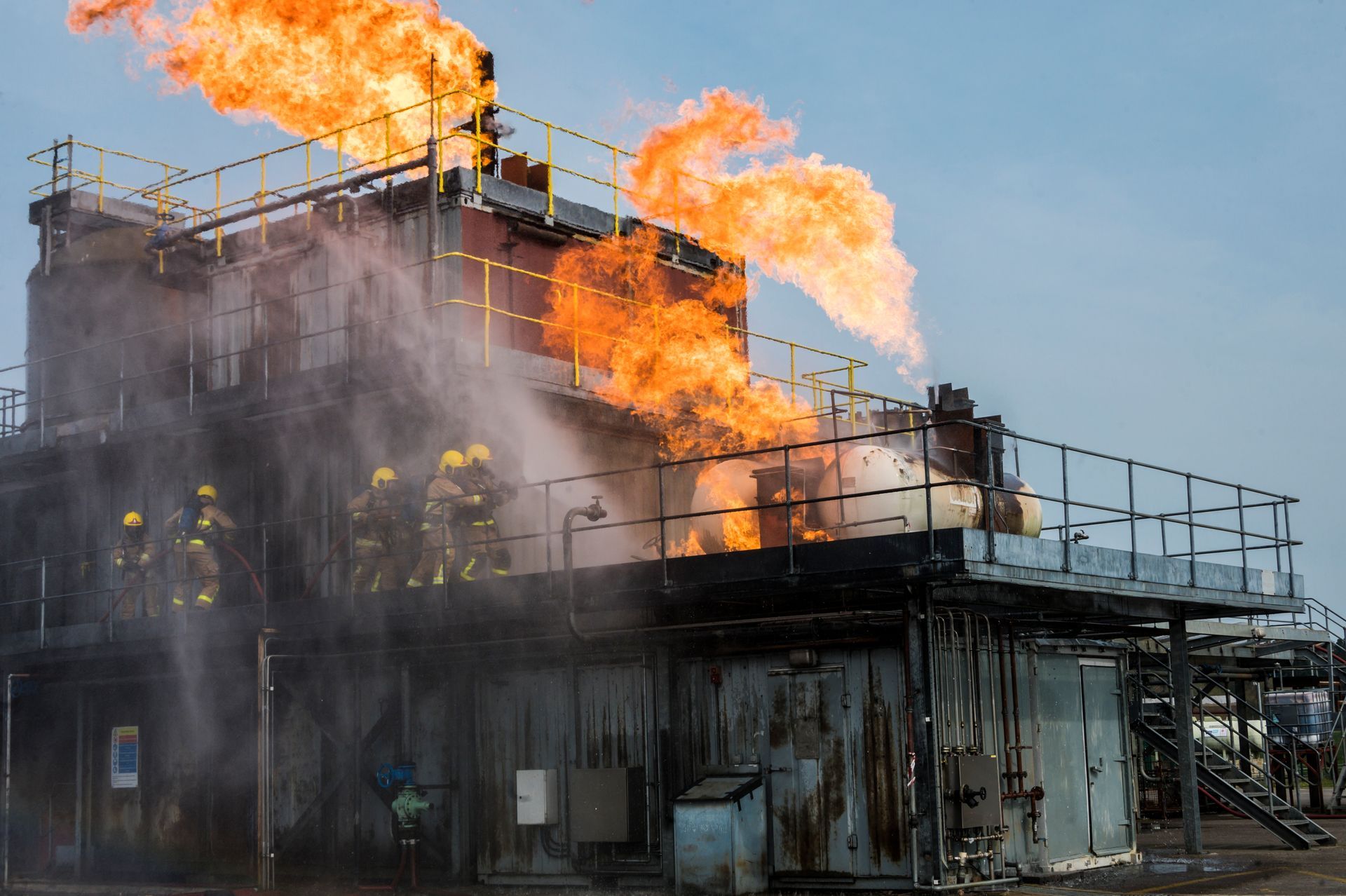
In these places, owners of facilities that store 2 million gallons or more of liquid fuels will be required to present certificates of financial responsibility to the Department of Environmental Quality (DEQ) demonstrating that they have the funds set aside to cover the worst-case costs passed on to public agencies and nearby communities in the event of catastrophic spills or explosions, such as those that may occur as a result of the anticipated Cascadia Subduction Zone (CSZ) earthquake (which could top 9.0 on the Richter scale).
One of the first accomplishments of the fossil fuel risk bond work we initiated in 2016 was a 2021 risk assessment completed by the firms ECONorthwest, Salus Resilience, and Enduring Econometrics. The study – funded by Multnomah County Resolution 2019-091 – found that in the event of magnitude 8 or 9 CSZ quake a massive release of 95–194 million gallons of fuel would likely occur, some of which would catch fire and potentially result in a one or more catastrophic explosions. At the high end, such a spill would be larger than the Deepwater Horizon disaster (~134 million gallons). The study estimated that economic damages could top $2.6 billion in the form of clean-up costs, harmful effects on human health, lost and contaminated ecosystems, reduced property values and harms to navigation. With HB 4100 now the law of the land, fossil fuel infrastructure owners, not taxpayers, will be responsible for paying cleanup costs and compensating businesses and individuals for at least some of these damages through payouts from financial assurance mechanisms such as surety bonds, performance bonds, trust accounts, or corporate guarantees.
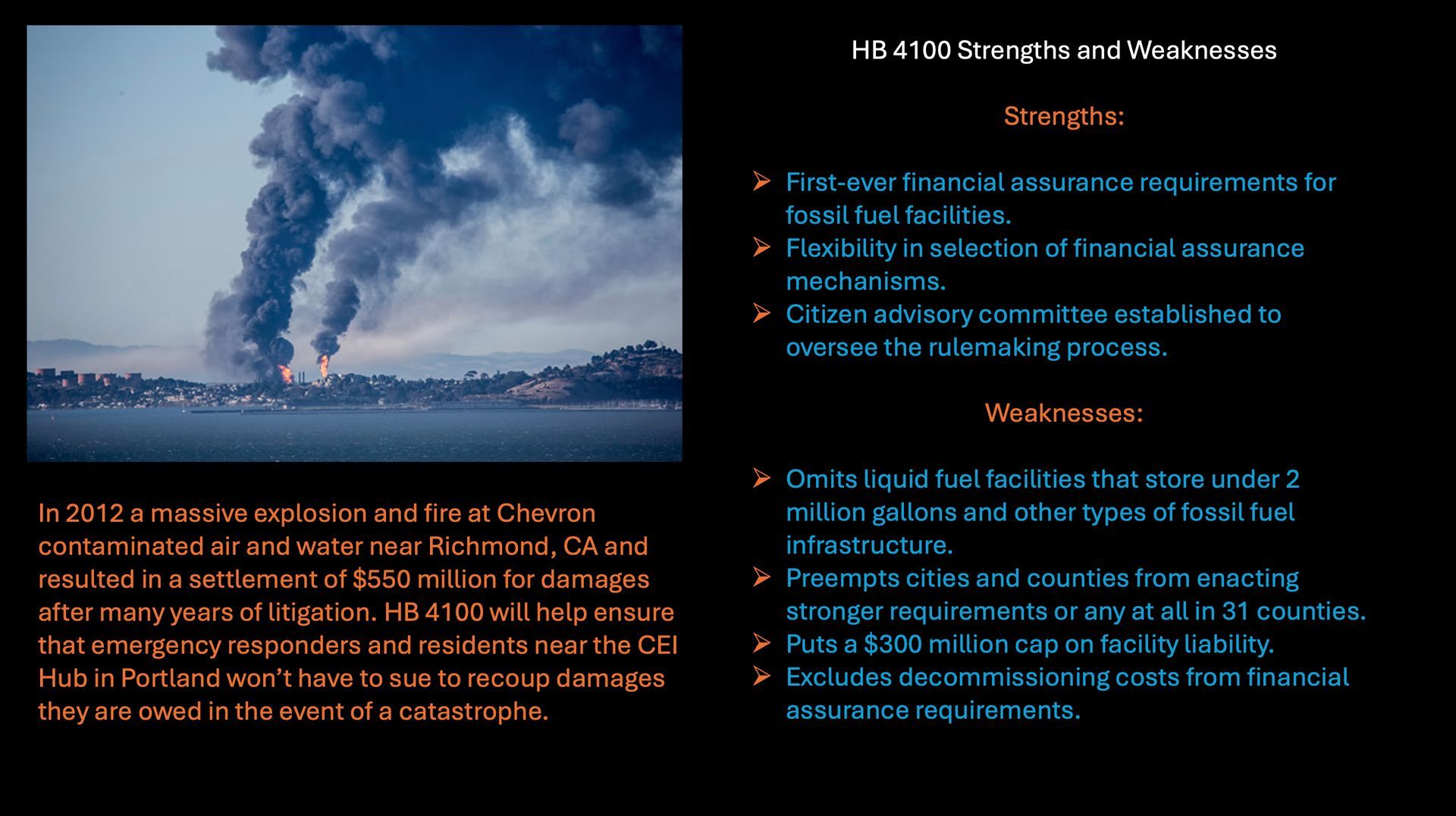
HB 4100 – Strengths and Weaknesses
In a short session like 2026, it is remarkable to have any significant environmental legislation passed. But through the tireless efforts of advocates such as Portland’s Risky Business Coalition, the CEI Hub Task Force, Oregon Physicians for Social Responsibility, Willamette Riverkeeper and others, HB 4100 made it over the finish line. But as is often the case with legislative victories, there were compromises made along the way that will need to be remedied either in the context of DEQ’s forthcoming rule-making process or in subsequent legislative sessions when the bill can be amended.
Key strengths of what passed this session include first-of-its-kind financial assurance requirements for fossil fuel facilities, flexibility in what financial assurance mechanisms owners can choose from, and establishment of a citizen advisory committee to help oversee the rule making process. Key weaknesses include a $300 million cap on facility liability, language preempting cities or counties from enacting stronger regulations, and omission of decommissioning costs from the required financial assurance coverage.
Next Steps for Fossil Fuel Risk Bonds in Oregon
For the three counties (Multnomah, Clatsop, and Lane) where HB 4100 applies, DEQ’s rule making process will provide a forum for ensuring that the certificates of financial responsibility obtained from fossil fuel infrastructure owners are adequate to cover all potential economic damages externalized onto taxpayers and communities adjacent to hazardous facilities in the event of a catastrophe. But because DEQ has a significant degree of discretion, there is a danger that regulators simply focus on clean-up costs and discount other public agency outlays associated with repairing damages or compensating victims. CSE and its partners will be participating in the rule-making process to guard against this outcome.
For the remaining 31 Oregon counties, HB 4100’s preemption language is highly problematic since these counties are barred from doing anything at all on financial assurances for risky fossil fuel (or so-called “renewable fuel”) infrastructure. When CSE first proposed fossil fuel risk bonds in 2016, we did not anticipate the rapid rise of so-called “renewable natural gas” (RNG), or biogas derived from large-scale manure digesters. While often framed as a climate solution, RNG has increasingly become a driver of industrial livestock expansion.
Policies and subsidies intended to support climate action are, in practice, incentivizing the growth of large confined animal feeding operations (CAFOs) to produce manure and methane for sale into energy and carbon markets. This dynamic is exacerbating environmental and public health harms in frontline communities. In Sunnyside, Washington, for example, the nation’s largest proposed biodigester would be sited in a low-income, predominantly Latino community already burdened by some of the highest levels of air and water pollution in the country. Rather than reducing emissions at the source, these projects risk locking in and expanding the very systems that generate methane in the first place.
For Oregon counties currently not covered by HB 4100, there are ways to move forward on bonding for decommissioning and bonding for other types of liquid or gaseous fuel infrastructure not addressed, such as large fossil methane or biogas pipelines. And statewide, there is nothing in HB 4100 that prevents the state or counties from implementing the second major prong of liquid or gaseous fuel risk bond programs – namely, surcharges on greenhouse gases to begin to get the funds in place for climate adaptation.
In a 2025 report CSE published with the Forum on Oregon Climate Change Economics (FORCE), we estimated that a surcharge of as little as $5.60 per ton of CO2 emitted from fossil (or other liquid or gaseous) fuel combustion and industrial logging activities would be enough to generate $22.3 billion by 2050 to fund several big ticket climate adaptation programs related to comprehensive cooling centers, resilient forests, micro-grids, acquisition of sensitive lands and retrofit of extreme-risk highways.
Stay tuned on this site for updates on these efforts as well as a review of next steps in Washington State, where some of the strongest fossil fuel risk bond language has been in place since 2022 and where an important new rule-making process has begun that provides us an opportunity to significantly strengthen financial assurance requirements.